| Genre | Experimental electronic music |
| Impact | |
| Origin | Soviet Union, 1950s |
| Status | Largely underground and marginalized at the time |
| Pioneers | Composers and sound engineers |
| Influences | Soviet vision of a technologically-advanced communist future |
| Characteristics | Electronic instruments • Tape manipulation • Avant-garde sensibility |
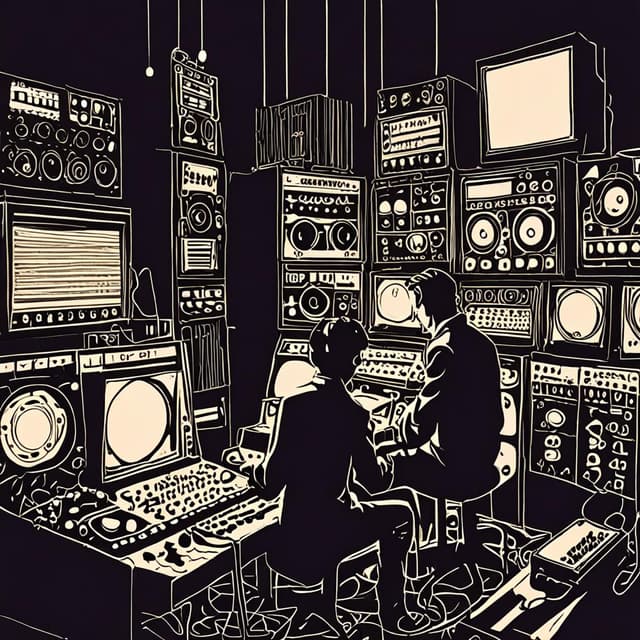
Experimental electronic music is a genre tracing its origins to the 1950s in the Soviet Union. Emerging from the vision of a technologically-advanced communist society championed by the Soviet regime, this early electronic music was characterized by the extensive use of custom-built synthesizers, tape loops, and musique concrète techniques. Exploring radical new sonic textures and non-linear compositional structures, the "Soviet futurists" who pioneered this genre sought to create a music aligned with the regime's utopian ideals.
The origins of experimental electronic music can be traced back to the Theremin and other early electronic musical instruments developed in the Soviet Union during the 1920s and 1930s. However, the genre truly took shape in the 1950s, driven by composers and sound engineers working at state-sponsored studios and research institutes.
Key early figures included Evgeny Murzin, the inventor of the ANS synthesizer, and Andrei Smirnov, a composer who helped establish the Moscow Experimental Studio in 1957. These artists drew inspiration from the work of Pierre Schaeffer and the Groupe de Recherches Musicales in France, but infused their music with distinctly Russian and Soviet influences.
The experimental electronic musicians of 1950s-60s Soviet Union saw themselves as part of a broader "Soviet futurist" movement, aligned with the regime's vision of a technologically-advanced communist utopia. Their music was intended to soundtrack and reflect this vision, incorporating elements of traditional Russian folk and classical music alongside radical new electronic timbres and structures.
Prominent themes in Soviet futurist electronic music included:
Politically, the Soviet futurists were walking a fine line, as their avant-garde aesthetics could be seen as challenging the state's prescribed socialist realist art. But they justified their work as serving the greater good of the communist project.
The experimental electronic composers in the USSR had a complex and often tense relationship with the authorities. While their work was officially sponsored and supported by state-run studios and research institutes, they were also under constant scrutiny.
The KGB monitored their activities, and several leading figures were subject to interrogation, censorship, and even imprisonment for perceived political transgressions. At the same time, the regime recognized the propaganda value of showcasing the USSR's technological prowess through futurist electronic music.
This dynamic led to a precarious balancing act, with the composers constantly navigating political minefields to continue their work. Many resorted to metaphorical or ambiguous messaging to avoid censorship, while others actively embraced the system in the hopes of advancing their vision.
Despite being largely confined to the underground in their heyday, the innovations of the Soviet futurist electronic musicians would go on to have a profound impact on subsequent musical genres. Their use of tape loops, circuit-bending, and unconventional sound sources prefigured the development of industrial music and ambient music in the West during the 1970s and 1980s.
Moreover, the experimental Soviet composers' fusion of electronic textures with traditional Russian musical elements anticipated the later rise of folktronica and other hybrids of electronic and folk idioms. Their ideologically-charged, quasi-utopian vision also influenced the aesthetics of later "cyberpunk" and "industrial" subcultures.
While much of the original Soviet futurist electronic music remains obscure and inaccessible, a renewed interest in this historical lineage has emerged in recent decades. Reissues, academic studies, and homages by contemporary artists have all contributed to a growing awareness and reappraisal of this crucial but underappreciated chapter in the history of electronic music.
